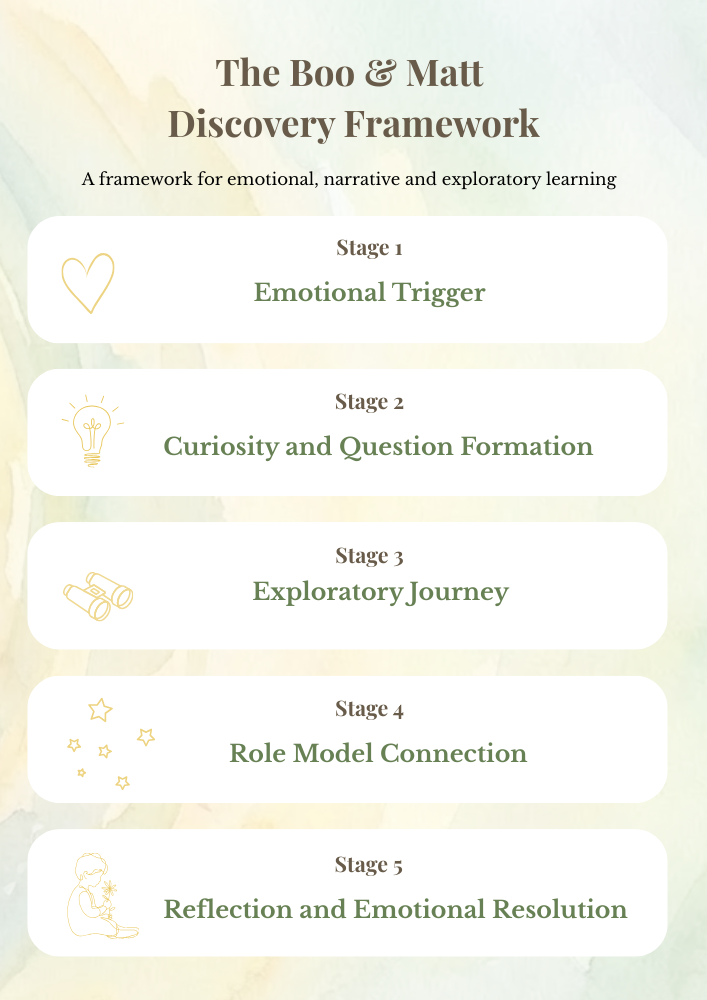
The Boo & Matt Discovery Framework
A framework for emotional, narrative and exploratory learning
Every Boo and Matt adventure follows a simple discovery journey.
A real emotion becomes a question, the question opens a journey, and the journey leads to understanding.
Through this process, children learn that curiosity can transform feelings into discovery.
Every story begins with a recognizable emotional experience such as frustration, fear, curiosity or uncertainty.
Developmental psychology shows that emotion strongly influences attention and memory formation. When children emotionally identify with a situation, they become more receptive to learning.
Research in early childhood education shows that emotional engagement helps children retain information and connect experiences with meaning.
In the Boo and Matt stories, Matt wonders why something happens. Why airplanes do not fly. Why the sky is dark at night. Why scientists kept trying even after failure.
Educational research describes curiosity as the primary driver of intrinsic motivation in learning.
When children ask questions themselves, the brain activates networks associated with exploration and reward.
The narrative introduces a historical journey where children encounter real innovators and scientists.
This stage reflects principles of experiential and inquiry based learning, where knowledge emerges from observation, experimentation and reflection.
Children are introduced to real historical figures who faced uncertainty, tested ideas and learned from failure.
Meeting a real historical figure helps children see that discoveries come from curiosity and persistence rather than perfection.
Research in educational psychology shows that role models increase self efficacy and motivation in young learners.
Children begin to see themselves as capable of learning and discovering.
The story returns to the present. Matt now understands the situation differently and feels more confident trying again.
This closing moment connects emotional growth with knowledge.
Reflection is an important step in constructivist learning, helping children integrate new understanding into their worldview.
The Boo & Matt Discovery Framework draws on decades of research in early childhood development, social emotional learning, early literacy, and curiosity driven STEM education.
Studies from institutions such as Harvard University’s Center on the Developing Child, the National Science Foundation, CASEL, the OECD, and the American Academy of Pediatrics show that children learn best when emotional engagement, storytelling, and exploratory learning are combined during the early years.
If you would like to explore the fascinating science of how children learn and discover the world, we invite you to read our blog with research, talks, and educational resources.